







RECIPES


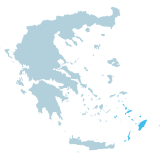
On Anafi Island, lies the rock of Kalamos, the second highest monolithic limestone after Gibraltar; a must-see for climbers who will enjoy a great challenge here.
The first philosopher is considered to be Thales of Miletus (c. 624 – 425 B.C.). He is credited as giving the first explanation for the origin of the world that was not mythological.
The species and subspecies of the native plants in Greece are about 6,000, almost as much as 50% of the native plants of Europe!
700 plant species of Greece are endemic, meaning that they may be found only in Greece; approximately 20% of those are aromatic or medicinal plants.
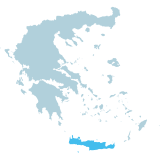
Crete's history as well as the inhabitants' personality were affected by the island's mountainous landscape.
Greece has more archaeological museums than any other country in the world; in-fact they are around 196!
Greece's national drink is ouzo. Ouzo is a dry anise-flavoured aperitif. Cheers, "stin igia mas" in Greek!
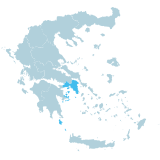
Athens is one of the few coastal cities worldwide that is surrounded by mountains. These are Mt. Hymettus, Mt. Penteli, Mt. Parnitha and Mt. Aigaleo.
Did you know that Greece is the third largest producer of olive oil in the world? Greeks have cultivated olive trees since antiquity. Some of the olive trees that are still producing olives, date back to the thirteenth century.
Greece is the place where democracy was born. But democracy in ancient Athens was significantly different from modern democracies. It was both more participatory and exclusive, and there were no political parties in Athenian democracy.
Did you know that in Greece you can enjoy skiing with a sea view?
Greece has historically engaged in wine making. Take for example Dionysus, the son of Zeus, the God of the grape-harvest, winemaking and wine. His face is seen today on the sommelier’s pin which is a symbol of respect to wine’s contribution throughout history.
Did you know that Greece is the third largest producer of olive oil in the world? Greeks have cultivated olive trees since antiquity. Some of the olive trees that are still producing olives date back to the thirteenth century.
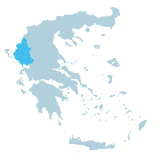
Did you know that Epirus is the most mountainous territory of Greece and the poorest in the EU; however it has a unique natural wealth!
Do you know what rakomelo is? It is a Cretan hot cocktail! A delicious mixture of honey, spices and the alcoholic beverage tsikoudia. Bottoms up!
The very first sprint race of the first Olympic Games in 776 B.C. was won by Coroebus of Elis, a cook!
Continuously inhabited for over 7,000 years, Athens is one of the oldest cities in Europe.
Olympus (2,917m), the mountain of Gods and Muses is the highest mountain of Greece and the 2nd in the Balkans.
Did you know that in Greece, 47 mountains are over 2000m., 105 mountains between 2000 and 1500m., 155 mountains are between 1500m. and 1000m. The number of mountains under 1000m. have yet not been recorded.
Alexander the Great, one of history’s greatest warriors and leaders of all time, was Greek. Alexander the Great conquered land all the way from Greece to Asia. His achievements and conquests gave rise to the later Hellenistic period (323 BC - 31 BC).
City of Experiences
A breathtaking combination of blue and green
The Lakeside Jewel of Northern Greece
An Untouched Paradise for Mountain Lovers
The land of the Nymphs
At the Foot of Mount Olympus
A Unique Macedonian Settlement
Where Nature's Bounty Embraces Ancient Legacy
An action-packed destination
A trip to the birthplace of the Olympic Games
A fascinating wine tourism destination
A Gem in the Centre of the Peloponnese
A legendary escape in every sense of the word
A Traditional Gem on the Slope of Mount Mainalo
Travel to the heart of the Cyclades
Timeless Roots, Vibrant Spirit
A rising destination in the Cyclades
The Big Blue
The "handmade" island
The island with heavenly beaches
Welcome to the Cyclades
The Exciting Island
Simply irresistible
An island of beauty and magic
The Elegant Island
An island of raw beauty
A balanced and harmonic cycladic island
Anti-conformist & carefree
The Chalk Island
Bathed in the sunlight of the Aegean Sea
A piece of heaven in the Lesser Cyclades
The head priest of the Cyclades
A Butterfly-Shaped Island
The Sponge Harvesting and Rock Climbing Island
The wild beauty of the Dodecanese
Wild and Beautiful
A Remote Treasure Island
Hippocrates’ Island
Calypso’s Island
A lesser known gem in the Dodecanese
Island with a Unique Volcanic Terrain
Religious legacy meets beauty of Nature
The island of vivid contrasts
A Fairytale-like Island
The perfect choice for a laid-back holiday
The island of the Great Gods
A Tapestry of Natural Wonders and Cultural Riches
An island of sheer beauty
The island of Hera and Pythagoras
The island of glorious past & pristine beauty
An archipelago away from the crowds
Τhe remote islands of ship owners
Share your moments in Greece